
E-commerce
Selling on Instagram? Where Your Orders Go After the DM
TechNewWings · 6 November 2026 · 6 min read
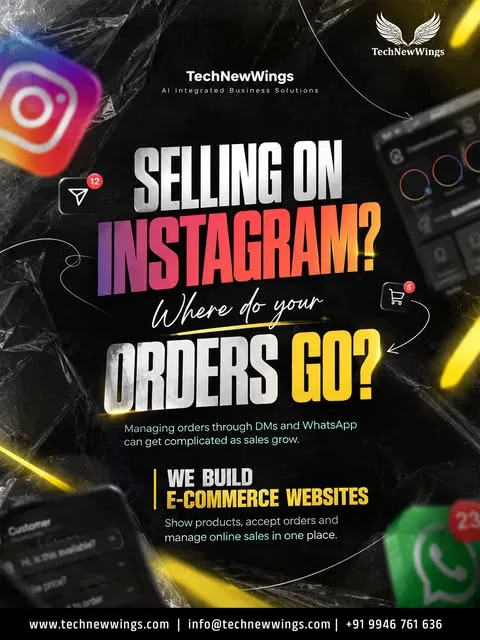
Short answer: Instagram and WhatsApp are great for getting attention and answering questions, but they are poor places to manage orders. As sales grow, DMs lose orders, oversell stock, hide payment status and forget repeat customers. Move order-taking to an e-commerce website or Shopify store, and keep social media as the front door.
Many Indian brands and small retailers start the same way. Post a product, get a DM, share a price, take a UPI screenshot, note the address and pack the order. At ten orders a week this works. At ten orders a day, the phone becomes the operations system, and it was never built for that.
What goes wrong when you sell through Instagram and WhatsApp DMs?
DM selling breaks because each order lives inside a conversation instead of a record. Stock, payment, address and delivery details are scattered across chats, screenshots and notebooks. As volume grows, orders are missed, items oversold, payments go unmatched and customers wait for updates nobody remembered to send.
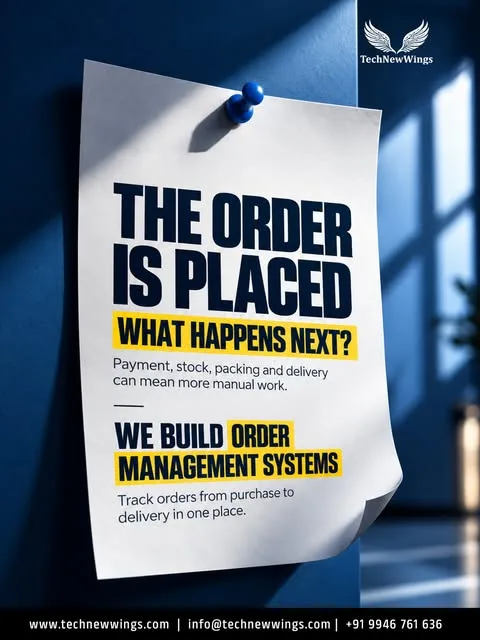
The sale is only one step. After a customer says “I’ll take it”, several things have to happen, and in a DM workflow each one is manual:
- Order capture. Size, colour, quantity and address are spread across several messages, sometimes over days.
- Stock. Two customers are promised the last piece because availability is tracked in someone’s head or a notebook.
- Payment confirmation. UPI screenshots arrive in chats and must be matched against bank statements by hand.
- Cash on delivery. COD orders need tracking until the courier collects and remits the money.
- Delivery updates. Customers message “Where is my order?” and someone has to look up the courier and reply.
- Repeat customers. Your best buyers are buried in old chats, so you cannot easily reach them with new launches.
None of this means Instagram is the wrong channel. It means the order process needs a proper home.
When should you move from DMs to an e-commerce website?
Move when managing orders starts taking more time than finding customers. Typical signs are missed or duplicated orders, overselling, slow payment checks, the same questions answered every day, and no record of repeat buyers. If one person cannot step away from the phone without orders stalling, the DM setup has outgrown itself.
Use this checklist to judge where you are:
- You have lost or forgotten at least one confirmed order in a chat thread
- Stock has been oversold because availability was not up to date
- Matching payment screenshots to orders takes real time every day
- Customers regularly ask for prices, sizes and delivery charges that could be on a product page
- COD orders are tracked in a notebook or spreadsheet
- You cannot quickly list your top repeat customers
- More than one person replies to DMs and they sometimes contradict each other
- You want to run ads but have nowhere to send traffic except a profile
If several of these apply, it is time to give orders a system of their own.
What does an e-commerce website change for your orders?
A store turns each sale into a structured order with the product, quantity, price, address, payment status and delivery status in one place. Customers browse and pay on their own, stock updates as orders come in, and your team works from an order list instead of searching through chats.
| Task | DM-based selling | E-commerce store |
|---|---|---|
| Showing products | Posts, stories, sent photos | Product pages with prices, variants and stock |
| Taking the order | Back-and-forth messages | Cart and checkout, captured in one step |
| Payment | UPI screenshot, manual check | Payment gateway marks the order paid |
| Cash on delivery | Notebook or spreadsheet | COD flagged on the order until collected |
| Stock | Memory or a separate sheet | Inventory reduces with each order |
| Delivery updates | Customer asks, staff replies | Status and tracking shared with the customer |
| Repeat customers | Lost in old chats | Customer history and order records |
Instagram and WhatsApp still matter. Product posts and bio links send people to the store, and WhatsApp handles questions, order updates and support. The difference is that the order itself lives in a system, not a chat.
What should your online store connect to?
At minimum, a store should connect to a payment gateway, a shipping or courier process and your stock records. As the business grows, it should also feed a CRM for customer follow-up and accounting or ERP for invoicing and inventory, so orders are not retyped elsewhere.
The order is placed; what happens next decides whether the store saves time or creates a new manual step. Plan these connections early:
- Payments. UPI, cards, net banking and COD, with paid status written to the order automatically.
- Shipping. Courier integration or a clear dispatch workflow, with tracking shared with the customer.
- Inventory. One stock figure used by the website and any physical shop, so you do not oversell across channels.
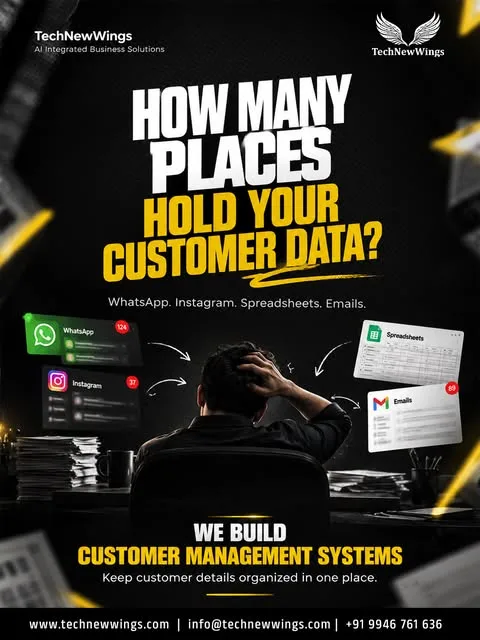
- Customer data. Customer records in a CRM for repeat campaigns and follow-up, instead of scattered across WhatsApp, Instagram, spreadsheets and email.
- Billing and accounts. Invoices with GST details created from orders, not typed again. Our guide on turning WhatsApp orders into ERP records covers this handoff.
If you already run Shopify and the gaps are between stock, CRM and WhatsApp, read connecting Shopify inventory, CRM and WhatsApp.
Which e-commerce option fits your business?
TechNewWings offers three routes. E-commerce Development builds a complete store for retailers, emerging brands and entrepreneurs. Shopify Development sets up and customises a Shopify store. Custom E-commerce Solutions suit businesses whose workflows, integrations or scale need something built around them. Support and maintenance are available for all three.
| Option | What it includes | Best for |
|---|---|---|
| E-commerce Development | Custom storefront design, product and catalogue management, inventory, cart and checkout, payment gateway integration, order and customer management, SEO and performance, mobile-friendly layout | Retailers, emerging brands and entrepreneurs moving off DM selling |
| Shopify Development | Store setup and configuration, theme customisation, product and collection organisation, payment, checkout and shipping configuration, app integrations, performance and search optimisation | Businesses that want Shopify’s hosted platform, set up properly |
| Custom E-commerce Solutions | Custom storefront and UI, business-specific workflows, custom product, order and inventory management, payment, shipping, ERP and CRM integrations, custom dashboards, scalable architecture; Android and iOS apps as additional scope | Businesses with specific processes or deeper system integration needs |
E-commerce Development is starting from ₹29,999. The final cost depends on scope: number of products and variants, integrations, custom features and whether you need mobile apps. Shopify and custom projects are quoted after we understand your requirements.
After launch, ongoing support covers updates, security and feature enhancements, so the store keeps pace with the business. You can see storefront work such as Electrofit, a fitness equipment e-commerce store for a UAE retail brand, on our work page, and read more about our approach on e-commerce development.
Next step
If your orders currently live in DMs, start by listing what happens after a customer says yes: payment, stock, packing and delivery. Then get started with TechNewWings and we will help you choose between a ready store, Shopify or a custom build, and scope what it needs to connect to.
Frequently asked questions
Can I keep selling on Instagram after launching a website?▾
Yes, and you should. Instagram stays your discovery and conversation channel. The change is that orders are completed on your website, where stock, payment and delivery details are recorded properly. Product posts, stories and bio links can point to product pages, and DMs can still answer questions before sending the customer a link to buy.
How much does an e-commerce website cost with TechNewWings?▾
Our E-commerce Development package is starting from ₹29,999. It covers a complete store with storefront design, catalogue and inventory management, cart and checkout, payment gateway integration, order and customer management, SEO basics and a mobile-friendly layout. The final cost depends on scope, such as product count, integrations, custom features and any mobile apps.
Should I choose Shopify or a custom e-commerce website?▾
Shopify suits businesses that want a proven hosted platform, standard checkout and a large app ecosystem, and are comfortable with its subscription and app costs. A custom store suits businesses with specific workflows, such as custom pricing, B2B ordering or deep ERP and CRM integration. We help with both, so the choice can follow your needs rather than our preference.
Can an online store handle cash on delivery?▾
Yes. Most e-commerce platforms and Indian payment setups support cash on delivery alongside UPI, cards and net banking. The important part is recording COD orders properly: marking them unpaid until delivery, tracking courier collection and reconciling payouts. Some businesses also restrict COD by order value or pincode to reduce failed deliveries and returns.
When is it time to move from Instagram DMs to a website?▾
Look for repeated signs: orders lost in DM threads, stock overselling, payment screenshots that are hard to match, customers asking the same questions daily, and no easy way to see who your repeat buyers are. If one or two people spend most of their day managing chats rather than growing the business, the DM-only setup has reached its limit.